munchfonts


Choose

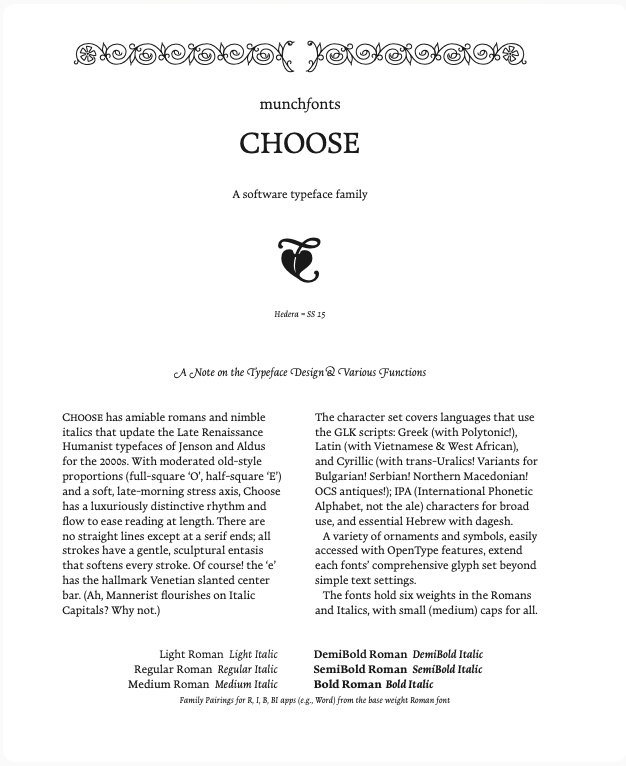
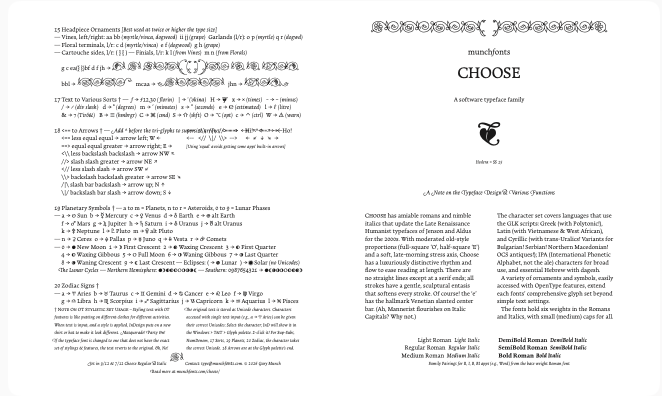
Choose has amiable romans and nimble italics that update the incunabula Venetian typefaces of Jenson and Aldus for the 2000s. With moderated old-style proportions (full-square ‘O’, half-square ‘E’) and a soft, late-morning stress axis, Choose has a luxuriously distinctive rhythm and flow to ease reading at length. Of course! the ‘e’ has the characteristic Venetian slanted center bar.

CHOICE.
CHOOSE.
Choose’s character set covers languages that use the GLK scripts: Greek (with Polytonic!), Latin (with Vietnamese), and Cyrillic (with trans-Uralics! Variants for Bulgarian! Serbian! OCS antiques!); IPA (International Phonetic Alphabet) characters for most (broad) uses; and basic (unpointed) Hebrew with dagesh.

Included OpenType features in Choose are: small caps in each of the GLK scripts; old-style and cap-height tabular and proportional numerals; small-cap numerals.
Italic GLK basic capitals have luxuriant flourished forms, to be used as initials and with typographic restraint.

Numerical sets to fit all cases. Common ligatures for the “fiffles,” and beyond, unusual ligatures for some capital pairs or tag words, arrows, and astronomic & astrological symbols fill out the character set.

CHOOSEY.
CHOOSE.
Six weights with accompanying Italics: Light, Reguar, Medium, DemiBold, SemiBold, Bold.
Capitals, lowercase, and Small Caps that are Medium, between Cap and lowercase—easily differentiating the three cases in all scripts.

CHOOSE.
CHOiCES.
Feature sets are numbered and named so the feature is identifiable in apps’ deeper interface elements (e.g., InDesign). Both the number and a brief descriptive title are references to what a style on a number-only list will do.

CHOICES.
CHOOSEN.
Scripts are localized behind the scenes with ‘locl’ to match the language of the document with preferred variants of letterforms for the language. For example, Bulgarian gets its Cyrillic ‘t’ shaped as ‘m’, Southern Cyillic gets its italic sha with overbar, an option to switch to the descending Cyrillic italic ‘de’ etc. The ‘locl’ features are backed up by available stylistic sets for situations where the document isn't tagged for that particular language.

Choose Rlg Choose RAX
Choose Text Setting

— Cicero: in Catilinam. Set in Choose Regular.


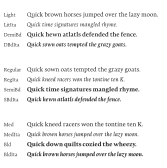
Six Weights and Italics

Six weights, Roman and Italic; family groupings


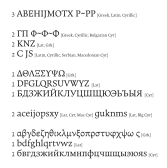
Common Forms, GLK

GLK scripts differ, but have several forms in common. [3: common to all three] [2: common to two].
But sound values for those forms can (and usually do) differ.


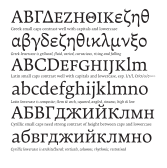
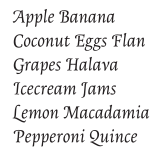
Greek, Latin, Cyrillic roman

Roman — Three statures: Cap, Small cap, lowercase, respecting expectations of forms.


Greek, Latin, Cyrillic italic

Italic — Three statures: Cap, Small cap, lowercase, respecting expectations of forms.


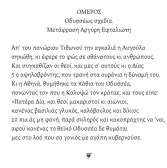
Greek roman text; Homers Odyssey

Greek script roman — Homer’s Odyssey.

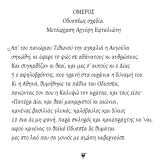
Greek italic text; Homers Odyssey

Greek script italic — Homer’s Odyssey, with ligating cursive alternates.


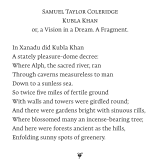
Latin roman text; Coleridges Kubla Khan

Latin script roman — Coleridge’s Kubla Khan.

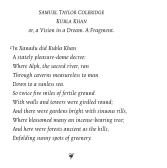
Latin Italic text; Coleridges Kubla Khan

Latin script Italic — Coleridge’s Kubla Khan.


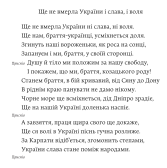
Cyrillic roman text;  Ukrainian Anthem

Cyrillic script roman — Ukrainian National Anthem.

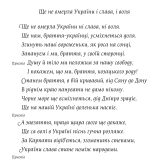
Cyrillic Italic text; Ukrainian Anthem

Cyrillic script Italic — Ukrainian National Anthem.


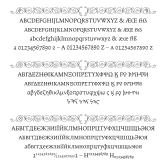
Swahes for running titles

Italic Swashes for GLK titling or all-caps setting, IF YOU MUST (you don’t).

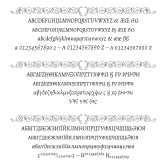
Flourishes for occasional use

Spacing Italic Flourishes for GLK titling. Use sparingly!
Similar forms are used for Marginal Initial Flourishes; these extend into the margin, beyond the text box.


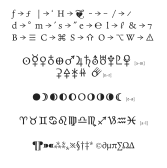
Odd Sorts

How to access a variety of interesting odd sorts. Glyph palettes work, too.

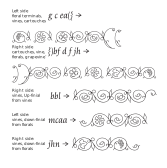
how-to grow a vine

How to grow a vining headpiece or incidental ornament.


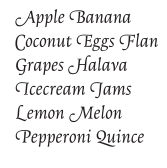
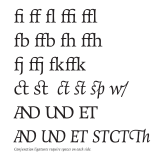
Roman Ligatures

Roman ligatures for Latin script text; standard, and discretionary.

small caps are medium caps

The Small Caps are actually Medium Caps, between cap-height an x-height.
This ensures clear hierarchy between similar forms in small caps and lowercase, especially in the Cyrillic!

grapes

Vine parts are equal across weights and styles.

Choose

CHOOSE was built first in FontLab Studio 5.4 in 2003; and sat around waiting to blossom in 2025 & 2026. From FLS5 to FontLab 8 was an easy leap into modern times; most of my finger-trained shortcuts were reproducible, or otherwise implemented in the interface. It’s been quite a revolution from early 1990s and swinging Bèziers in Fontographer on a Mac Plus (with 2 MASSIVE megabytes of memory).

¶ Years later, It’s a Mac Air, with a great ASUS mega monitor (dozens of high-density sample windows for comparison and context, please, yes), and FL8.4.

Fonts are tested in Adobe InDesign, of course, and Illustrator. Images here were built in Illustrator and exported as SVG for perfect scalability on the Web.

¶ There are no doubt errors and ommisions in them, as in any human endeavor—any notes are welcome; suggestions, warnings, storm or otherwise, might be entertaining.

¶ What’s next? There is a sketch from 2004, for an Armenian extension in one weight; and a start on Cherokee (I was one of a few who answered the call for more type options made at TypeCon New Orkeans, and worked on several fonts in consultations and critiques with Joseph Erb). If there is time, another go at Arabic (the Grotik (q.v.) has a decent set but wants attention).

¶ This page and all others on munchfonts.com were built by hand, using basic HTML and CSS. LOL. It’s simple after fontwork!

¶ © Tuesday 23 June 2026 by Gary Munch.
In time for the 2026 Typographic Festival.
Read On! Litera Scripta Manet.


Downloads (next update, tomorrow)
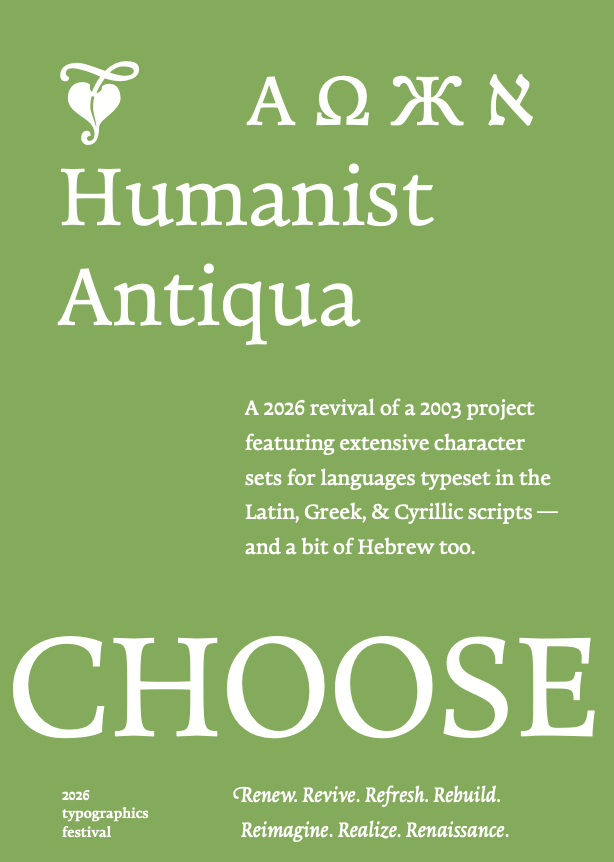
||| VincaWind Video ||| 2026 Typographics Festival Card front & back |||
Typographer's Guide to Using Choose
||| PDF half legal, single pages to two full sheets both sides (short-edge binding) ||| PDF imposed on full legal, to two sheets both sides |||